
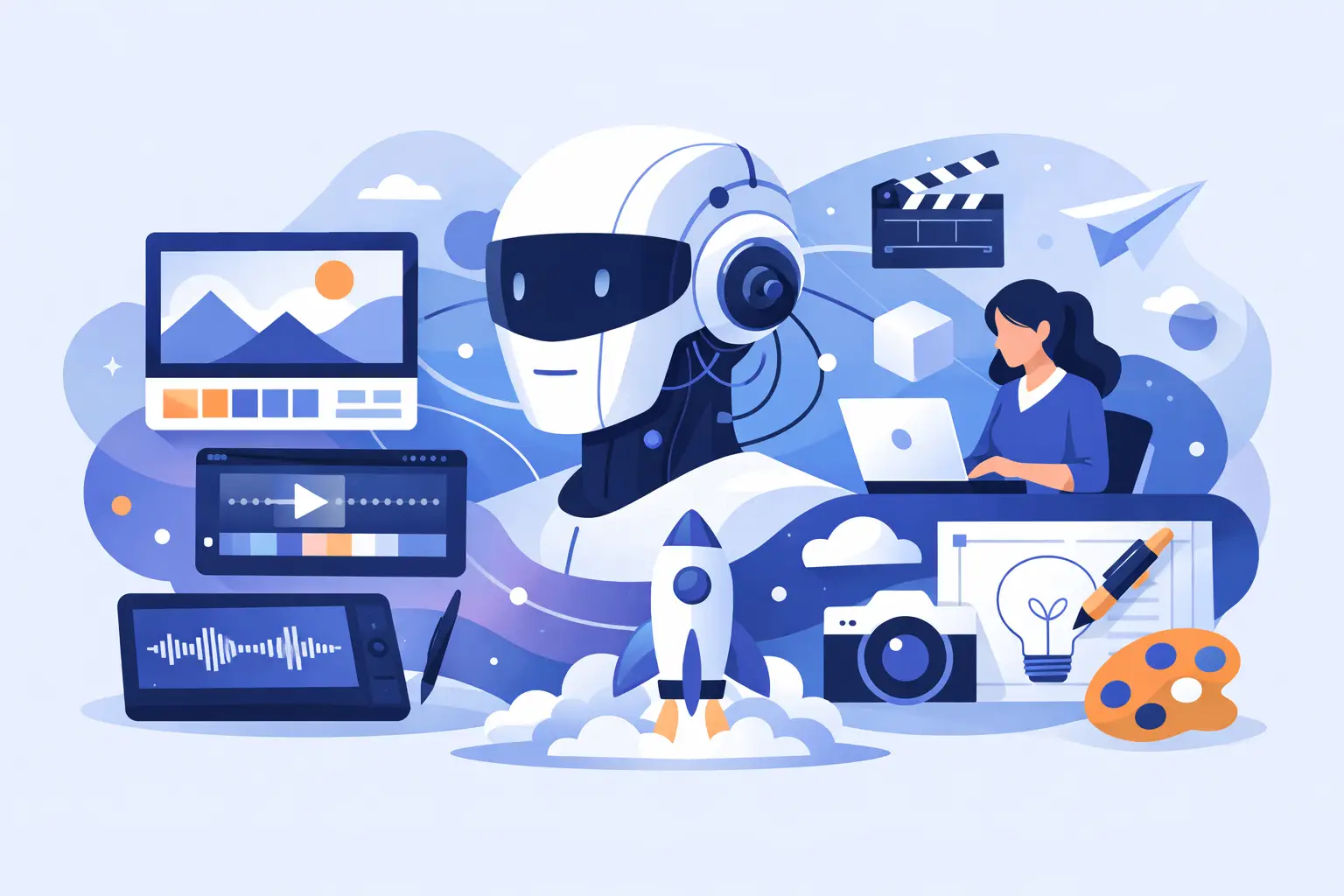
A campaign idea should not stall because it needs a designer, a video editor, a voice actor, a music license, and three separate software subscriptions. An all in one AI creative platform changes that equation by turning a written concept into the assets a real campaign needs: product visuals, short-form video, narration, music, and finished ad creative.
For marketers and operators working against launch dates, the value is not simply generating an image faster. It is reducing the distance between an idea and a usable piece of marketing. That means fewer handoffs, fewer exports, fewer decisions about which tool handles which part of production, and more time spent testing creative that can actually move a business forward.
The Problem Is Not Creation - It Is Fragmentation
Most teams do not struggle to come up with a campaign concept. They struggle to get that concept through production. A simple paid social idea can require product photography, graphic design, motion, copy, voiceover, audio, editing, approvals, and multiple file versions sized for different placements.
Traditional production still has a place, especially for flagship brand campaigns, real customer testimonials, or footage that must feature a specific physical product in precise detail. But it is often too slow and expensive for the constant volume of creative required by ecommerce, social channels, performance advertising, and product launches.
Using separate AI tools can create a new version of the same problem. One app generates images. Another turns a still into video. A third creates narration. A fourth provides music. The work may start quickly, but it becomes fragmented as soon as the files need to fit together. Teams spend time moving between interfaces, adapting prompts to different systems, tracking subscriptions, and making assets feel like they belong in the same campaign.
An integrated platform is designed to solve the workflow problem, not just the generation problem.
What an All in One AI Creative Platform Should Produce
A useful creative workspace should start with the final deliverable, not a single isolated output. The goal is not to collect impressive AI experiments. The goal is to produce creative that can run.
For most growth teams, that starts with images. A prompt can create product-inspired lifestyle scenes, campaign key art, social posts, display concepts, and visual directions that would otherwise need a photoshoot or design brief. Strong image generation is particularly valuable in early concepting, when testing several creative angles matters more than perfecting one expensive direction.
From there, motion makes the work more useful. A still image can become a short product moment, a stylized brand scene, or a scroll-stopping social video. Video is often the highest-demand asset and the biggest production bottleneck, so the ability to move from idea to motion within the same workspace changes the pace of iteration.
Audio completes the message. Voiceovers give ads a clear narrative. Music can establish energy, mood, and timing. When audio is produced alongside visuals, creators can build for a complete viewing experience rather than attaching sound at the last minute.
The final layer is assembly. A platform should help turn those ingredients into ad-ready creative, with a coherent visual direction and a message that works in the intended format. This is where an all-in-one approach earns its name. The output is not just an image, a clip, or an audio file. It is a campaign asset with a job to do.
Why Model Choice Still Matters
A unified experience should not mean settling for one model's strengths and weaknesses. Different generative models are better at different jobs. Visual realism, stylized composition, readable text in images, motion quality, and natural voice generation are distinct capabilities.
That is why access to specialized technology matters, even if the user never needs to manage the technical details. FLUX can support high-quality visual creation. Kling and Veo bring motion capabilities into the production workflow. Ideogram can be valuable where text rendering matters in image-based creative. ElevenLabs supports expressive, natural-sounding voiceovers.
For a marketer, the practical benefit is choice without operational sprawl. You can focus on the creative brief instead of opening separate model interfaces, learning different billing systems, and moving files from one disconnected tool to another.
Nox AI brings these capabilities into one production studio so a campaign can move from prompt to finished multimedia creative without forcing a team to build its own AI tool stack.
Start With a Campaign Brief, Not a Vague Prompt
AI creative improves when the input is treated like a brief. A short prompt can work for exploration, but commercial output benefits from clarity about the audience, product, offer, platform, and desired response.
Instead of asking for "a cool skincare ad," describe the commercial moment: a premium skincare serum on a sunlit bathroom counter, close-up texture, clean editorial styling, soft neutral palette, vertical video composition, aimed at busy professionals, with a confident and calm tone. Then add the actual message the ad needs to communicate, such as hydration, a limited-time offer, or a product launch.
This does not mean every prompt needs to be long. It means each detail should earn its place. The strongest inputs usually establish the subject, setting, visual style, format, and marketing purpose. If a result misses the mark, adjust one or two variables rather than rewriting everything at once. That makes it easier to learn what is driving the output.
Build Variations Around One Clear Angle
Speed becomes valuable when it creates better decisions, not just more files. Begin with a single campaign angle, then create controlled variations around it. Test a different opening visual, setting, product benefit, hook, narration style, or call to action.
For example, an ecommerce brand promoting a travel bag might test one version centered on organization, another on durability, and another on weekend escape. Each angle can have its own image, short video, voiceover, and music direction while retaining the same overall brand feel.
This approach gives performance teams a wider set of meaningful tests. It also protects brand consistency because the core brief stays stable while individual variables change.
Where an Integrated Workflow Saves the Most Time
The largest gains tend to appear in recurring production, not one-off experiments. Social media managers can build a weekly content pipeline without scheduling a new shoot for every post. Founders can create launch assets before a full production budget is available. Agencies can develop early creative directions for client review without spending days on speculative work.
It is especially useful for performance marketing. Paid campaigns need fresh hooks and visual concepts to avoid creative fatigue. Waiting weeks for every new variation can slow learning and waste media spend. An integrated workflow lets teams respond faster to results: keep the winning audience and offer, then develop new creative expressions around them.
There are trade-offs. AI-generated product visuals should be reviewed closely when accuracy matters. Packaging, logos, labels, legal claims, and product-specific details may need refinement before publication. Regulated industries also need their normal approval processes for messaging and disclosures. Fast generation does not replace brand governance or marketing judgment.
The right operating model is simple: use AI to expand creative capacity, then apply human review where precision, compliance, and brand standards matter most.
Choose a Platform Based on Finished Work
When evaluating an AI creative platform, look past the number of models listed on a product page. Ask what your team can complete in one session. Can you create a visual concept, make it move, add a voiceover and music, and shape it into an ad without rebuilding the project across several tools?
Also consider whether the platform supports the formats your business actually needs. A brand focused on TikTok and Reels needs vertical video and rapid hooks. An ecommerce operator may need a high volume of product-led images and paid social variations. An agency may need more room for concept exploration across several client styles.
The best choice depends on your production bottleneck. If your challenge is ideation, image generation may be enough. If the problem is getting campaigns out the door, a connected multimedia workflow is far more valuable.
The most useful test is a real one: take next week's campaign brief, create multiple directions, and see whether the output is close enough to review, refine, and deploy. When a prompt can become a complete creative starting point instead of another file waiting for a handoff, your team has more room to test sharper ideas and ship work while the opportunity is still there.