
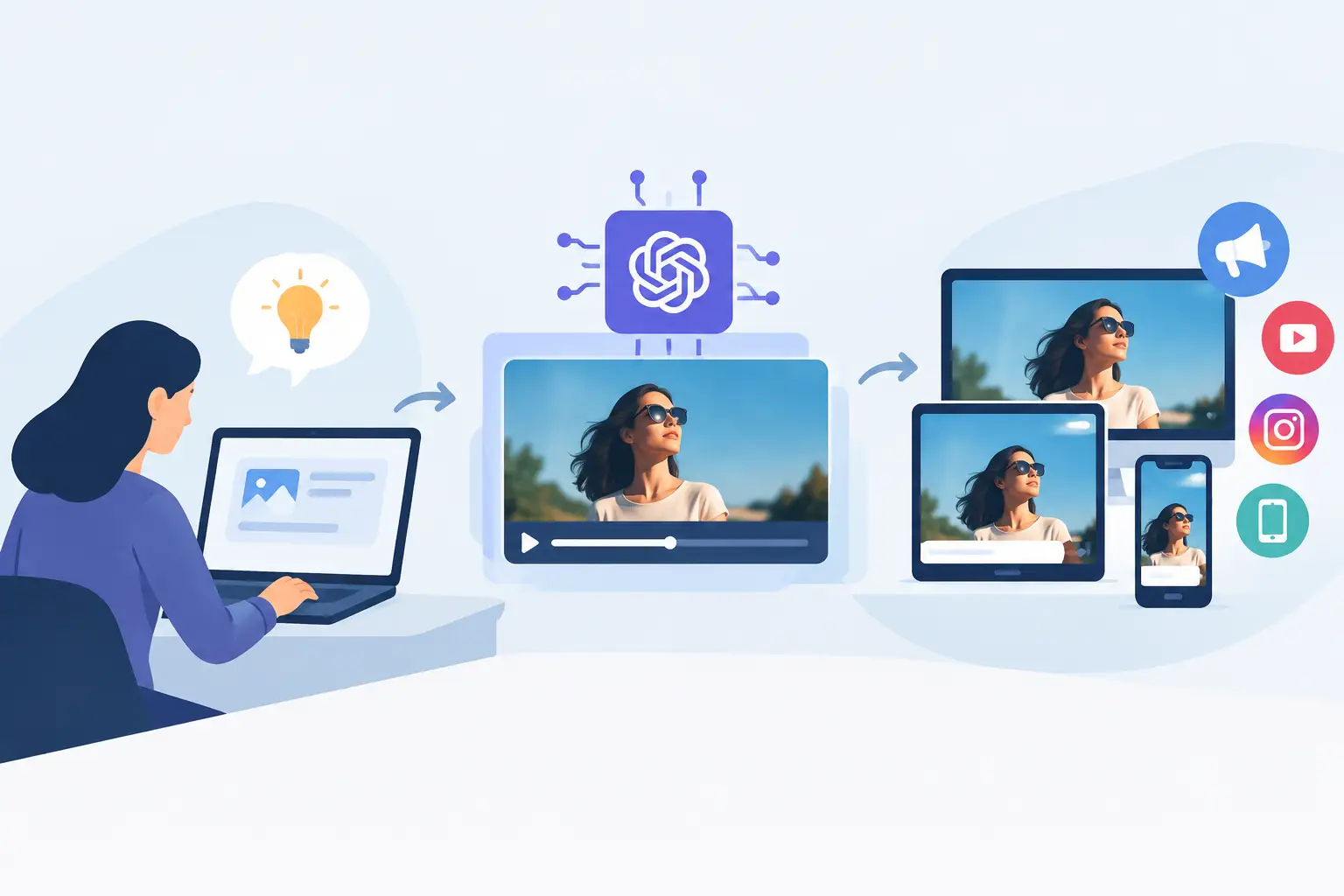
A paid social campaign cannot wait three weeks for a shoot, an edit, a voiceover session, and five rounds of handoffs. AI commercials give marketers a faster route from a campaign idea to ad-ready creative - without treating every new concept as a full production project.
The opportunity is bigger than making one impressive video from a prompt. The practical value is building a repeatable system for creating product visuals, motion, narration, music, and variations that fit real channels, real audiences, and real launch calendars. When the workflow is right, a small team can test more angles while keeping the brand recognizable.
What AI Commercials Actually Change
Traditional commercial production is organized around specialists. A concept moves from strategist to copywriter, designer, photographer or videographer, editor, voice talent, and sound team. That process can produce excellent work. It also creates cost, scheduling pressure, and a long gap between an idea and the market feedback that tells you whether it works.
AI changes the production model by compressing those steps into a connected creative workflow. A marketer can begin with a product benefit and audience insight, then generate a visual direction, short-form video scenes, voiceover options, music, cutdowns, and static companion assets from the same campaign brief.
That does not mean every commercial should be fully generated. A founder-led story, a high-stakes brand film, or a product demo that requires exact physical accuracy may still benefit from a conventional shoot. The advantage of AI is not that it replaces every production decision. It makes more decisions testable before a team commits time and budget.
For ecommerce brands, that can mean exploring ten hooks for a new product launch instead of choosing one. For agencies, it can mean presenting distinct visual territories before pre-production starts. For social teams, it can mean responding to a trend while it is still relevant rather than after the moment has passed.
Start With the Campaign Outcome, Not the Prompt
The fastest way to get weak creative is to ask for “a cool ad” and accept the first result. Strong AI commercial production starts with the same inputs that make any ad work: a clear audience, a specific offer, one message, and a defined action.
Before generating anything, write a compact production brief. State who the viewer is, what they should notice in the first two seconds, the product benefit that matters most, the objection the ad needs to answer, and the action you want them to take. This is not extra paperwork. It is the instruction set that keeps visuals, copy, and audio from drifting into separate ideas.
Consider a skincare brand introducing a vitamin C serum. “Create a luxury skincare video” is vague. A more useful direction identifies the audience and tension: busy professionals who want brighter-looking skin without adding a complicated routine. The hook might show a rushed morning, the product enters quickly, and the voiceover lands a single proof-oriented message. That gives every generated asset a job.
A focused brief also helps teams make better trade-offs. If the goal is efficient paid social testing, speed and clarity may matter more than cinematic complexity. If the goal is a homepage hero film, image quality, pacing, and product detail deserve more iteration. The format should follow the commercial objective, not the novelty of the technology.
Build for the placement first
A commercial designed for a 30-second landing page video should not simply be cropped into a vertical social ad. Each placement has different viewing behavior. A TikTok or Reels ad needs immediate movement and a visible message before the viewer scrolls away. A YouTube pre-roll may need a tighter opening claim. Display placements may rely on a single product image and sharp headline rather than motion at all.
Plan the core idea as a system. Develop one campaign message, then create a vertical video, square or portrait images, short cutdowns, alternate hooks, captions, and audio variants around it. This is where generative production earns its value: not by creating random volume, but by producing coherent assets from a shared direction.
A Production Workflow for AI Commercials
A commercial is a sequence of decisions, not one prompt. The most reliable workflow moves from concept to components, then from components to finished ads.
First, establish the creative territory. Generate reference-quality images that define the setting, cast, product styling, lighting, color, wardrobe, and mood. Review them as a marketer, not as a spectator. Ask whether the image makes the product category clear, whether it supports the offer, and whether it looks credible in the feed where it will appear.
Next, turn selected directions into motion. Short scenes usually perform better when each shot has one simple action: a hand reaches for the product, a creator reacts to a result, a package arrives at a door, or a close-up shows texture and detail. Trying to force an entire story into one complex generation often creates inconsistent subjects, strange motion, or unclear product use.
Then add the commercial structure. Lead with a hook, move quickly to the product and benefit, support the claim with proof or demonstration, and close with a direct call to action. Voiceover can carry the message efficiently, but it should not repeat text already filling the screen. Let on-screen copy reinforce the key point while the narration adds context, pace, or personality.
Music is not decoration. A track can establish energy and make cuts feel intentional, but it cannot rescue a vague offer. Choose audio that supports the audience and platform. A high-tempo beat may work for an impulse-purchase social ad; a calmer track may better suit a considered wellness or home product. Keep voice clarity ahead of musical drama.
Finally, assemble and review the complete ad in the context where it will run. Check captions, safe areas, legibility on a phone screen, logo timing, product accuracy, and the final call to action. A beautiful opening frame is wasted if the offer is unreadable or the product is introduced too late.
Nox AI is built around this connected process, bringing image, video, voice, music, and finished ad creation into one workspace rather than pushing teams between disconnected tools and production handoffs.
Where Quality Control Still Matters
Generative tools can accelerate output, but faster output also makes it easier to publish an avoidable mistake. The commercial standard remains the same: the work must be clear, credible, on-brand, and suitable for the claim being made.
Product fidelity deserves special attention. If your package design, logo, shade range, ingredients, interface, or product dimensions must be exact, review every frame closely. Generated visuals can introduce small errors that viewers may not consciously name but still notice. For regulated categories such as health, finance, alcohol, or supplements, have the appropriate team review claims, disclaimers, and implied outcomes before launch.
Brand consistency is another common pressure point. One generated asset may look polished while the next uses a different color palette, product shape, or tone of voice. Solve this upstream by defining a clear visual system and reusing approved references, language, and creative directions. Consistency is not a restriction on experimentation. It is what makes experimentation recognizable as your brand.
Rights and representation also require judgment. Use only materials, names, and claims you have permission to use. Avoid prompts that imitate a living artist, celebrity, or competitor campaign. Review casting and scenarios for stereotypes or accidental exclusion. The speed of generation raises the need for a disciplined approval process, not lowers it.
Test Angles, Not Just Edits
The greatest performance gain usually comes from testing a better message, not changing a transition. AI makes it practical to test creative angles that would have been expensive to produce separately.
For one product, you might create versions centered on convenience, savings, social proof, a problem-solution story, a seasonal use case, and a product demonstration. Each can have different hooks, visuals, voiceovers, and calls to action while sharing the same offer and brand system.
Keep the test interpretable. Change one major variable at a time when possible. If you replace the hook, visual style, voice, offer, and edit pace in every version, you will not know what influenced the result. Start with a clear hypothesis, such as whether a before-and-after opening outperforms a founder quote for first-time buyers.
Use performance data to guide the next batch. Low thumb-stop rates point to a weak opening. Strong viewing but poor clicks may signal an unclear offer or call to action. High clicks with weak conversion can indicate that the ad overpromises or that the landing page is not carrying the message forward. AI gives teams more creative shots on goal; measurement tells them which shots deserve more budget.
Keep the Human Work Where It Counts
The best AI commercials do not feel like technology demonstrations. They feel like advertising that understands a customer, shows a product clearly, and gives someone a reason to act.
Let AI handle the production friction: rapid concepting, visual exploration, asset variation, motion generation, narration options, and first-pass assembly. Keep human attention on positioning, taste, accuracy, approval, and performance learning. That division creates speed without surrendering judgment.
Your next campaign does not need a larger production calendar to become more ambitious. Start with one precise audience insight, build a complete asset system around it, and give the market more than one reason to respond.