


A paid social campaign can lose momentum before the first ad goes live. The brief needs visuals, the visuals need motion, the video needs a voiceover, and every channel needs its own version. Learning how to use AI in marketing changes that production equation. The practical value is not generating a random image or a clever caption. It is turning one clear campaign idea into polished, testable creative before the market moves on.
How to Use AI in Marketing: Start With the Outcome
The strongest AI marketing workflows begin with the asset you need to ship, not the tool you want to try. Define the commercial job first: generate product demand, explain a feature, retarget cart abandoners, launch a seasonal offer, or give your sales team stronger creative for outreach.
Then write a brief with enough direction to produce on-brand work. Include the audience, product, offer, desired action, channel, visual style, and one core message. A prompt such as "make an ad for our skincare brand" leaves too much to chance. A direction like "create a 15-second vertical video for busy professionals promoting a fragrance-free moisturizer, with clean editorial lighting, a calm confident voice, and a first-purchase offer" gives the production process a real target.
AI performs best when it has constraints. Your brand colors, product claims, customer language, prohibited phrases, and required calls to action should all be part of the input. Better instructions reduce revision cycles and make output more useful from the first generation.
Build One Concept Into a Full Campaign
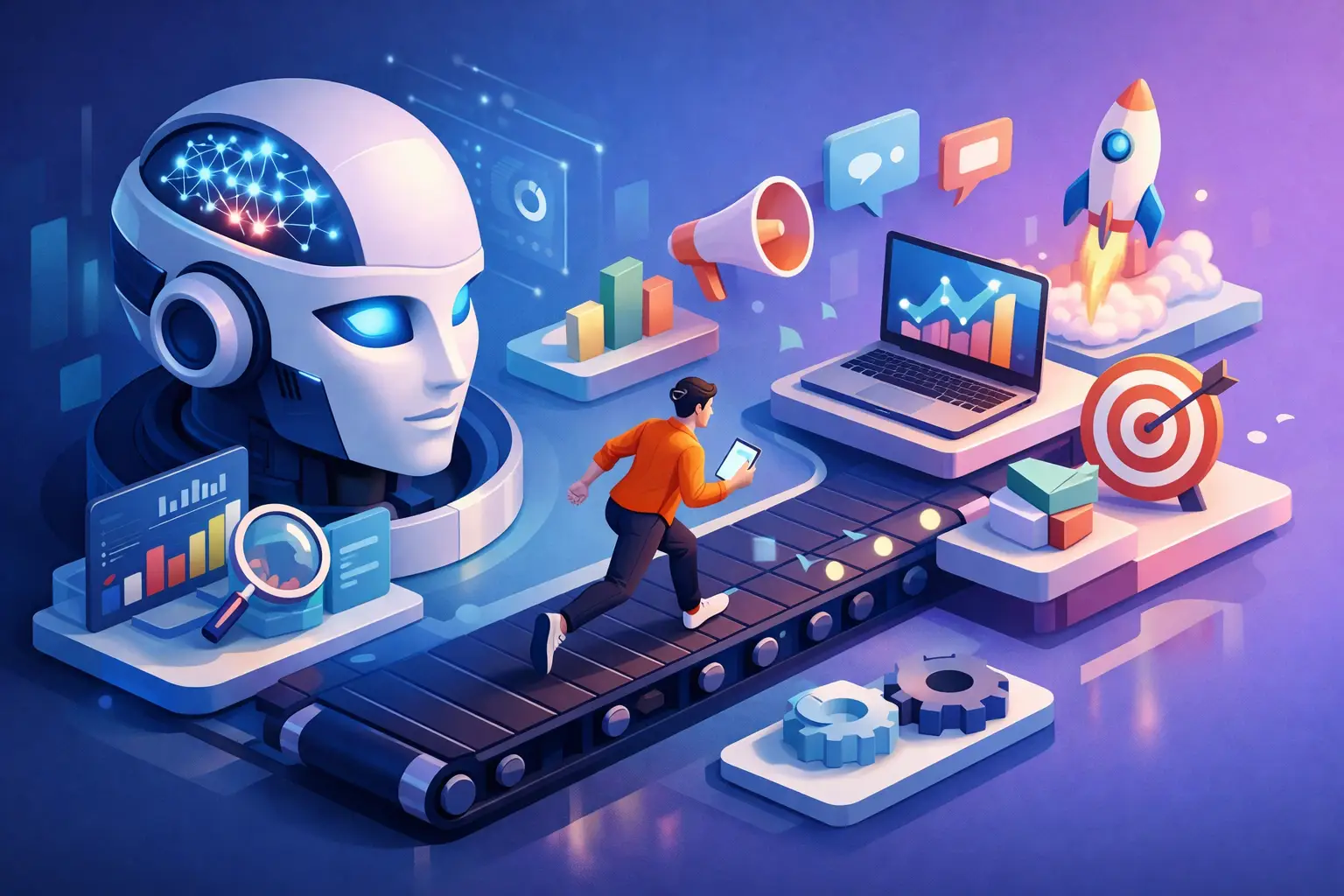
A conventional creative workflow treats images, video, copy, music, and voice as separate jobs. That creates handoffs, delays, and inconsistent campaign execution. AI makes more sense as a connected production system: establish a visual idea, expand it into multiple formats, then refine the pieces that prove their value.
Create visual directions before committing to one
Start by generating several distinct creative territories from the same brief. A direct-response ad may need a product-first image with a clear offer. The same campaign could also test a lifestyle scene, a problem-and-solution setup, or a bold typographic concept.
This is where speed produces better judgment. Instead of spending days choosing a single direction before production begins, your team can review a wider set of viable options in one working session. Keep the alternatives meaningfully different. Changing only the background color does not teach you much. Changing the emotional hook, setting, or message hierarchy can.
Choose a small number of directions that match the channel and audience. Product detail may matter most for a high-intent search or retargeting audience. A scroll-stopping visual concept may be more valuable for a cold social audience that has never heard of your brand.
Turn the best direction into motion and sound
Once a visual route is working, extend it into video. Use motion to make the message clearer, not simply to make the asset move. A product close-up can become a short demo. A static lifestyle scene can become a before-and-after story. A promotional graphic can become an offer-led vertical video with a strong opening frame.
Audio should serve the same idea. A voiceover can explain a benefit that is difficult to show quickly, while music can set pace and mood. But not every video needs both. For fast paid social placements, text on screen and product motion may outperform a fuller narrative. It depends on the product, the platform, and how much context the customer needs before acting.
The goal is creative consistency across formats. If the image promises precision, premium quality, or playful energy, the video and voice should reinforce that promise rather than introduce a different personality.
Produce variants with a reason
AI makes it easy to create dozens of assets. That does not mean every campaign needs dozens of near-duplicates. Generate variations around a testable hypothesis.
For example, one set of ads can test an aspirational message against a practical message. Another can test a founder-style voiceover against a polished brand narration. You can also vary the opening three seconds, product framing, headline, offer, or call to action. Change one major variable at a time when possible, so the performance data tells a useful story.
For ecommerce teams, this can mean creating versions for product launches, bundles, reviews, seasonal promotions, and retargeting without booking a new shoot for each one. For agencies, it means giving clients more credible creative options without building a larger production queue.
Use AI Where Production Creates Bottlenecks
The best use cases are often the work that is valuable but hard to justify through traditional production. Fresh creative for ad fatigue, localized campaign versions, product concept mockups, and rapid promotional videos all benefit from faster generation.
AI is also effective for early-stage creative exploration. Before commissioning a major shoot, build visual prototypes that help stakeholders align on the campaign's look, message, and emotional direction. This does not replace high-end photography or a carefully produced brand film when those assets are strategically necessary. It helps you reserve those investments for moments where craft, physical detail, talent, or brand visibility demand them.
Use it to extend the life of a strong campaign, too. One winning concept can become new aspect ratios, revised offer versions, alternate hooks, fresh background environments, and short-form video. The campaign stays recognizable while the execution stays current.
Keep Brand Control in the Workflow
Fast production without governance creates its own problems. AI-generated marketing assets still need human review for accuracy, brand fit, and platform compliance. Treat the output as production-ready creative that earns approval, not content that should publish untouched.
Create a simple review standard. Confirm that product details are correct, claims are supportable, logos and text are rendered properly, and the creative reflects your brand's visual rules. Pay particular attention to regulated industries, pricing, promotions, and testimonials. Speed is useful only when it does not create legal, operational, or customer-trust issues.
It also helps to maintain a campaign library of approved prompts, styles, product references, and messaging patterns. Over time, this becomes a practical creative system. New team members can produce within the brand instead of starting from a blank page, and agencies can move faster without losing the client's identity.
Measure Creative Output Against Business Results
AI can reduce production time immediately, but the real metric is whether the creative performs. Track production efficiency alongside campaign results. Look at time from brief to launch, cost per usable asset, number of concepts tested, click-through rate, conversion rate, and return on ad spend.
Do not assume that the fastest-generated asset will be the winner. The advantage is that faster production gives you more opportunities to find the winner. Review results by concept, message, format, and audience. If a product demo consistently beats lifestyle footage for new customers, that insight should shape the next round of generation.
This feedback loop separates productive AI adoption from content volume for its own sake. Your creative engine should get smarter with every campaign, building on actual customer response rather than internal opinions alone.
Choose a Workflow Built for Finished Creative
Managing separate generators for images, video, voice, music, and ad assembly can recreate the fragmentation AI was supposed to remove. A unified workspace keeps the concept, assets, and revisions connected from the beginning.
Nox AI brings image, video, voiceover, music, and ad production into one creative workflow, with capabilities powered by models including FLUX, Kling, Veo, Ideogram, and ElevenLabs. For teams that need campaign-ready output rather than isolated experiments, the difference is practical: fewer tool switches, fewer handoffs, and more time spent improving the creative itself.
Start with one campaign that is currently slowed by production friction. Build a clear brief, create a small set of distinct directions, launch the strongest versions, and let performance decide what deserves the next round of creative investment.