




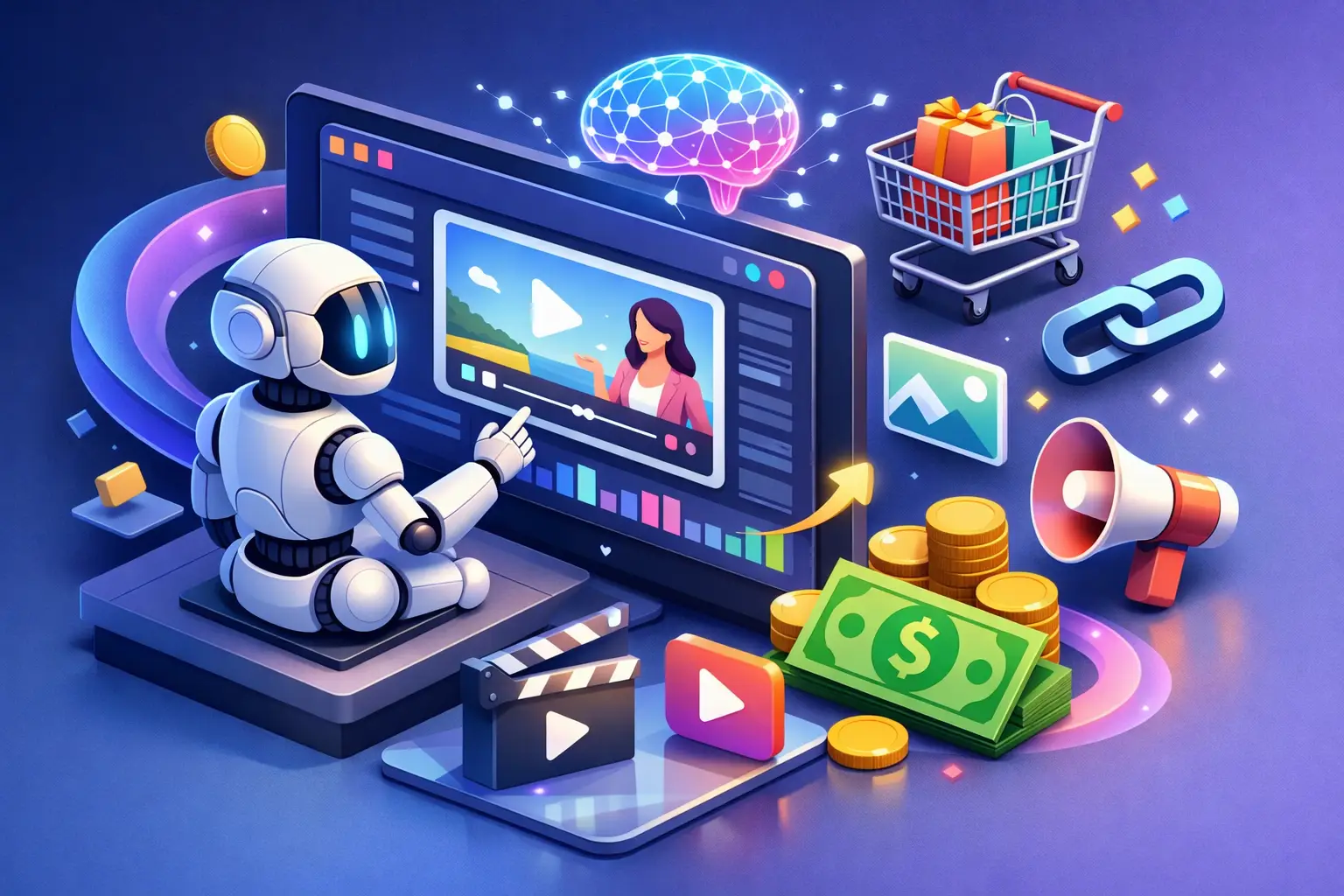
A product page can be well designed, competitively priced, and backed by a strong affiliate offer, yet still lose because the first video feels generic. In crowded feeds, ai generated videos for affiliate marketing give creators a faster way to turn an offer into a clear visual story - without waiting on a shoot, editor, voice talent, or a stack of disconnected tools.
The opportunity is not to publish more filler. It is to create more relevant creative: different hooks for different audiences, product-focused visuals for different objections, and new cuts when a campaign needs a fresh angle. The affiliates who get results use AI video as a production system, not a shortcut around strategy.
Why AI Generated Videos for Affiliate Marketing Work
Affiliate marketing depends on attention and trust. A link alone rarely communicates why a product deserves consideration. Video can demonstrate a use case, show the outcome, establish a point of view, and move viewers from curiosity to a qualified click.
Traditional video production creates friction at every stage. You need a concept, footage, script, editing, music, captions, voiceover, and multiple revisions. That process can make sense for a flagship campaign. It is much harder to justify when you need ten variations to test an offer, a seasonal promotion, or a new audience segment.
AI changes the economics of iteration. A creator can start with a simple prompt, generate product-relevant scenes, add narration and music, then produce ad-ready cuts for vertical placements. Instead of treating every new concept as a fresh production project, you can treat it as a focused test.
That speed matters most when the affiliate offer has a short promotional window, when paid social performance is changing, or when a creator is building content across several product categories. It also gives smaller teams access to polished visual output without staffing a full creative department.
Start With the Offer, Not the Video Tool
The strongest affiliate videos do not begin with a request for cinematic footage. They begin with a specific buyer problem and a credible product promise.
Before generating anything, define who the video is for, what frustration they recognize, and what the product helps them do. For example, a productivity app may appeal to overwhelmed freelancers who lose track of client work. A skincare product may appeal to buyers looking for a simpler routine. The visual direction, script, and call to action should all serve that one idea.
Avoid trying to explain every feature in a 20-second video. A short-form affiliate asset needs one job: earn attention, make the product feel relevant, and give the viewer a reason to learn more. If the product requires more education, create a sequence of videos rather than forcing a full sales page into one clip.
A practical creative brief can fit in a few lines: audience, problem, benefit, proof point, visual mood, format, and call to action. This gives AI generation a commercial direction instead of producing attractive but unfocused footage.
Build the Hook Around a Real Objection
The opening two seconds carry more weight than the closing transition. Lead with an outcome, a tension point, or a recognizable moment. “Still spending Sunday night organizing your week?” is more specific than “Try this amazing planning tool.”
The best hooks are native to the platform and honest about the offer. They do not need exaggerated claims to work. In fact, affiliate content often performs better when it feels like a useful recommendation from someone who understands the buyer's situation.
Create several hooks for the same core video. One might focus on saving time, another on lowering cost, and another on avoiding a common mistake. You can keep the product and visual concept consistent while testing the message that earns the strongest response.
Build a Video That Feels Complete
A usable affiliate video needs more than generated motion. It needs a clear structure that makes the message easy to follow on mute, with sound, and on a small screen.
Start with the hook. Move quickly to the product in context. Then show the result or key benefit, add a reason to believe, and finish with a direct next step. For many offers, that structure works in 15 to 30 seconds. Longer videos can work for tutorials, comparisons, and products that require more consideration.
Visuals should support the claim being made. If the video says a meal-planning service reduces decision fatigue, show an organized weekly plan and a relaxed evening routine. If it promotes ecommerce software, show the workflow becoming simpler rather than relying on abstract technology imagery.
Voiceover gives a campaign consistency and helps convey nuance that on-screen text cannot carry alone. Captions are equally valuable because many viewers watch without audio. Music should reinforce the pace without competing with the message. These are not separate finishing touches. Together, they determine whether the asset feels like a finished ad or an unfinished experiment.
Nox AI is built for this complete workflow. Creators can move from a text concept to images, video, voiceover, music, and finished promotional creative in one studio, with generation capabilities powered by models including FLUX, Kling, Veo, Ideogram, and ElevenLabs. The advantage is less time spent transferring files between tools and more time spent refining the message that drives the campaign.
Create Variations With a Purpose
More videos are only useful when each version answers a meaningful question. Randomly changing colors, music, and scenes can create noise without producing a learning loop.
Test one major variable at a time when possible. Keep the product and offer stable while changing the hook. Keep the hook stable while changing the audience scenario. Then compare whether the difference improves watch time, click-through rate, conversion rate, or cost per acquisition.
For a single affiliate offer, useful variations often include:
- A problem-first video that names the buyer's frustration
- A benefit-first video that shows the desired outcome
- A demonstration that shows the product in use
- A comparison angle that explains what makes the offer different
- A testimonial-style concept that frames the recommendation through experience
Each format works differently depending on the offer. Demonstrations are especially effective when the product has a visible workflow or tangible result. A problem-first concept can be better for products that solve an issue buyers already feel but have not yet named.
Keep an organized record of the prompt, script, audience, placement, and performance outcome for every test. Over time, this becomes a creative library that is far more valuable than a folder full of disconnected video files. You begin to see which claims, scenes, pacing choices, and calls to action consistently produce qualified traffic.
Protect Trust and Affiliate Compliance
AI video can improve production speed, but it does not remove the need for clear disclosure and accurate marketing. Viewers should understand when a recommendation includes an affiliate relationship. Put disclosures where people can reasonably see them, not only in a buried caption or profile page.
Be precise about product claims. Do not generate visuals that imply outcomes the product cannot reasonably deliver. Avoid invented reviews, fabricated expert endorsements, false scarcity, or before-and-after scenarios that distort the buyer's likely experience. These tactics may create a temporary spike in clicks, but they weaken the trust needed for sustained affiliate revenue.
There is also a practical brand-safety consideration. Review generated visuals, spoken copy, captions, and product details before publishing. AI can accelerate production, but the affiliate is still responsible for the final message. A fast review process protects both the audience and the relationship with the merchant.
Measure the Click After the View
Views are useful, but they are not the finish line. A video can earn strong watch time through entertainment and still bring in low-intent traffic. For affiliate campaigns, the more valuable question is whether the creative attracts the right viewer for the offer.
Track the full path: thumb-stop performance, average watch time, clicks, landing-page engagement, conversions, and earnings per click. If a video gets fewer clicks but produces more sales, it may be the better creative. If click-through rate is high but conversions are weak, check whether the video overpromises, the audience is too broad, or the landing page fails to match the message.
Use the results to make the next asset better. A winning hook can become several new videos. A weak call to action can be rewritten. A strong visual scene can be reused with a different audience story. This is where AI generation becomes commercially useful: it reduces the time between performance insight and the next creative decision.
The goal is not to replace judgment with automation. It is to give good judgment a faster production engine. When every video starts with a real audience need and ends with a clear, honest next step, affiliate content can feel less like an interruption and more like a recommendation worth acting on.